

Raising money for a nonprofit is very different from pitching a startup. Investors expect numbers and ROI; donors expect vision, trust, and proof that their support will truly make an impact. This is why the art of building a nonprofit pitch deck requires more than polished slides. It requires a careful balance of emotional storytelling and credible evidence.
In this article, I’ll walk you through how to create a nonprofit pitch deck that doesn’t just inform, but inspires action. To make it concrete, we’ll use a fictional case study—BrightFuture, a nonprofit that installs solar energy systems in rural African schools. By following this example, you’ll see how a clear structure, the right messaging, and professional templates can transform purpose into funding.
Why Nonprofit Pitch Decks Need a Different Approach
A business pitch deck sells growth, profit, and competitive advantage. A nonprofit pitch deck sells something deeper: the chance to be part of a solution that changes lives. If your deck feels like a plea, it risks sounding desperate. If it leans only on emotion, it may lack credibility. And if it focuses solely on data, it will feel cold and distant. The real key is balance.
Think of your pitch deck as an invitation. You are not asking for charity; you are offering people the chance to step into a movement, to see their contribution light up futures that would otherwise remain in the dark. This perspective changes how you write every slide, because it forces you to answer not just what your nonprofit does, but why it matters to the person reading.
The BrightFuture Example
Let’s imagine BrightFuture, a nonprofit that installs solar microgrids in schools across East Africa. The mission is simple: give children light so they can learn after sunset. To bring this mission to life in a pitch deck, BrightFuture weaves together the story of Samuel, a 12-year-old student whose life is shaped by whether or not he has electricity.
Title Slide – The Hook
BrightFuture opens its deck with a bold line:
“Powering Education With Solar Energy.”
Beneath the headline is a striking statement: “1 in 4 schools in sub-Saharan Africa have no electricity, leaving millions of students unable to study after dark.” Alongside the statistic is a photo of Samuel, standing under a kerosene lamp, trying to complete his homework before the flame burns out.

This combination of a universal fact and a personal story immediately sets the stage. It tells donors: this is not just an infrastructure problem—it’s an education crisis. With a professional Title Slide Template from SlidesDesign, the nonprofit ensures the first impression is as polished as it is powerful.
Mission and Vision – The Why
Next, BrightFuture explains its mission and vision in plain, compelling language.
Its mission is: “We bring sustainable solar energy to rural schools, ensuring that every child has the chance to study safely after dark.”
Its vision stretches further: “A future where every child, regardless of geography, has the light and resources they need to reach their full potential.”

Here, BrightFuture connects Samuel’s dream of becoming a doctor to its broader vision. Without light, his chances fade. With light, his future feels possible. The story gives the mission emotional gravity, and a Mission & Vision Slide Template adds clarity and visual focus.
The Problem – Making It Urgent
BrightFuture dedicates an entire slide to the scope of the problem. “Over 60% of schools in rural Kenya lack electricity. Students drop out earlier, test scores lag, and communities remain trapped in cycles of poverty.”
Samuel’s daily life illustrates this stark reality. After sunset, his home is too dark to read. His family can’t afford batteries or lamps. By morning, his assignments are incomplete, and his grades begin to suffer. What sounds like an energy issue is, in truth, an education barrier.

Please click nonprofit pitch deck if you want to get this template
The problem slide, supported by an infographic-style template, forces donors to feel both the scale of the crisis and its intimate human cost.
The Solution – BrightFuture’s Approach
With the problem clearly defined, BrightFuture introduces its solution: solar microgrids installed directly in schools. Each system powers classrooms, dormitories, and small computer labs. Each installation supports more than 500 students, and unlike diesel generators, solar grids are clean and sustainable.
For Samuel, the impact is immediate. He now studies in a well-lit classroom after sunset. He can use a shared computer for science lessons. His dream of becoming a doctor moves from fantasy to possibility.
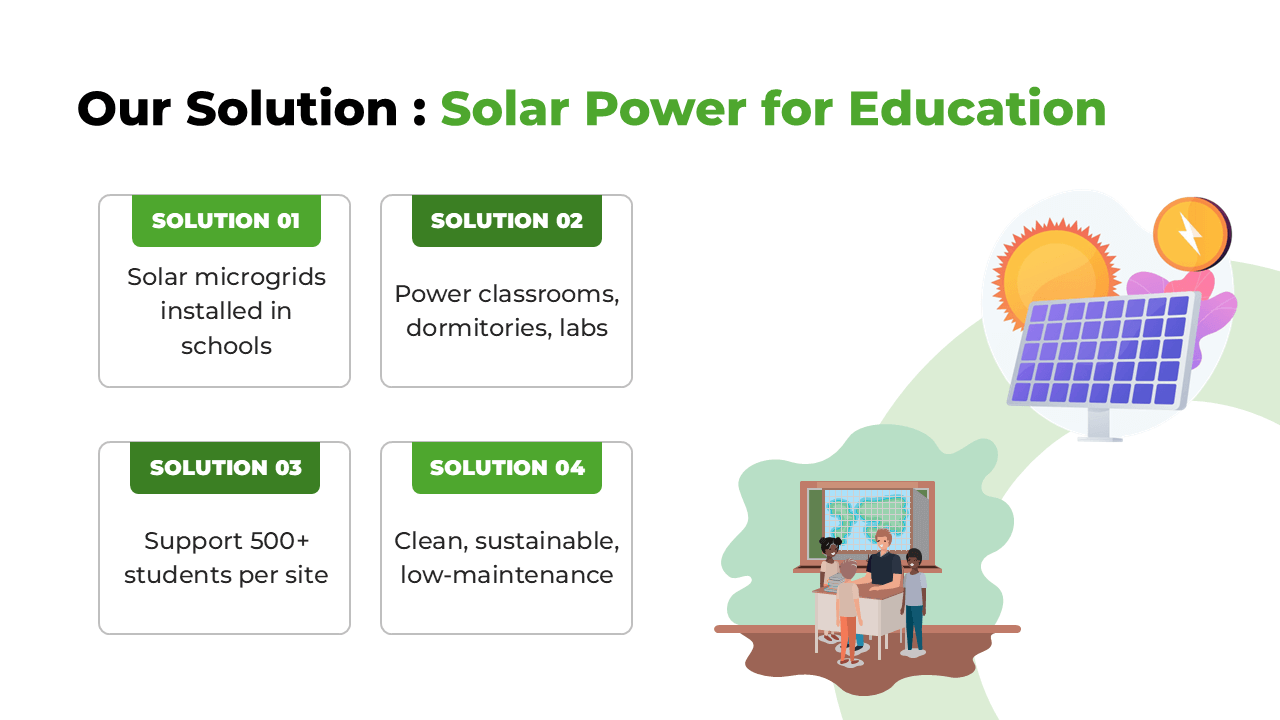
A Solution Layout Template makes the process easy to visualize, showing the installation phases and highlighting the simplicity of the model. Donors can immediately understand both the technical solution and its human outcome.
Impact Evidence – Proof That It Works
Storytelling must be grounded in evidence. BrightFuture quantifies its work:
20 schools electrified since 2020
12,000 students gained evening study access
Graduation rates increased by 40% in partner schools
This slide also features before-and-after photos: Samuel hunched under a dim lamp versus Samuel smiling in a solar-lit classroom. Numbers give credibility, but the image makes the story unforgettable.

With a Data Visualization Template, BrightFuture makes its case unambiguous: the model works.
Ongoing Projects – Showing Transparency
To reassure donors, BrightFuture outlines what is currently happening: “Five more schools are under installation, scheduled for completion by the end of this year.”
A roadmap-style template shows the timeline. Donors can literally see where BrightFuture has been and where it is heading. This transparency builds trust.
The Team – Faces Behind the Mission
Donors invest in people as much as projects. BrightFuture introduces its leadership:
Jane Mwangi, a renewable energy engineer with 12 years of experience
David Okello, a former UNICEF education program director
Photos of them working with local technicians emphasize authenticity. A Team Profile Template gives this section a professional finish.
The Ask and Future Goals – Converting Purpose Into Funding
Finally, BrightFuture makes the ask. “We are seeking $500,000 to bring solar power to 30 more schools, reaching 25,000 students.”
The funds are broken down clearly: $300,000 for solar installations, $100,000 for teacher training, and $100,000 for maintenance. By linking each dollar to a tangible outcome, BrightFuture reassures donors their contribution won’t disappear into overhead.
A Funding Ask Template shows this breakdown in an accessible chart.
Call to Action – Closing Strong
BrightFuture closes with urgency and clarity: “Every $20 brings light to one student. Join us in building futures that shine. Donate today at brightfuture.org/donate.”
The call to action is direct, measurable, and inspiring. With a Call-to-Action Slide Template, the message lands without clutter or distraction.
Why This Works
The BrightFuture example shows that a nonprofit pitch deck succeeds when it blends the heart and the head. Samuel’s story keeps the audience emotionally engaged, while the statistics prove credibility. Each slide flows into the next, leading donors from empathy to trust to action.
The deck is not a desperate plea but an invitation: “Here is a proven solution. Here is a child whose life it changes. And here is how you can help.”
A nonprofit pitch deck is more than slides; it’s a bridge between purpose and funding. By weaving stories and data, and by using professional templates to structure the narrative, nonprofits can transform their message from “please help” into “join us.”
If you’re ready to build your own impactful presentation, explore more nonprofit pitch deck templates. They’re built with this exact storytelling framework in mind, so you can add your mission, your numbers, and your story—and walk into any donor meeting with confidence.
⚠️ Note: BrightFuture and the story of Samuel are fictional examples created for illustrative purposes. Any resemblance to real people or organizations is purely coincidental.


